
新警察故事
《GTA6》泄露视频现实早有原型!老头往车厢里加油_我的网站

A |
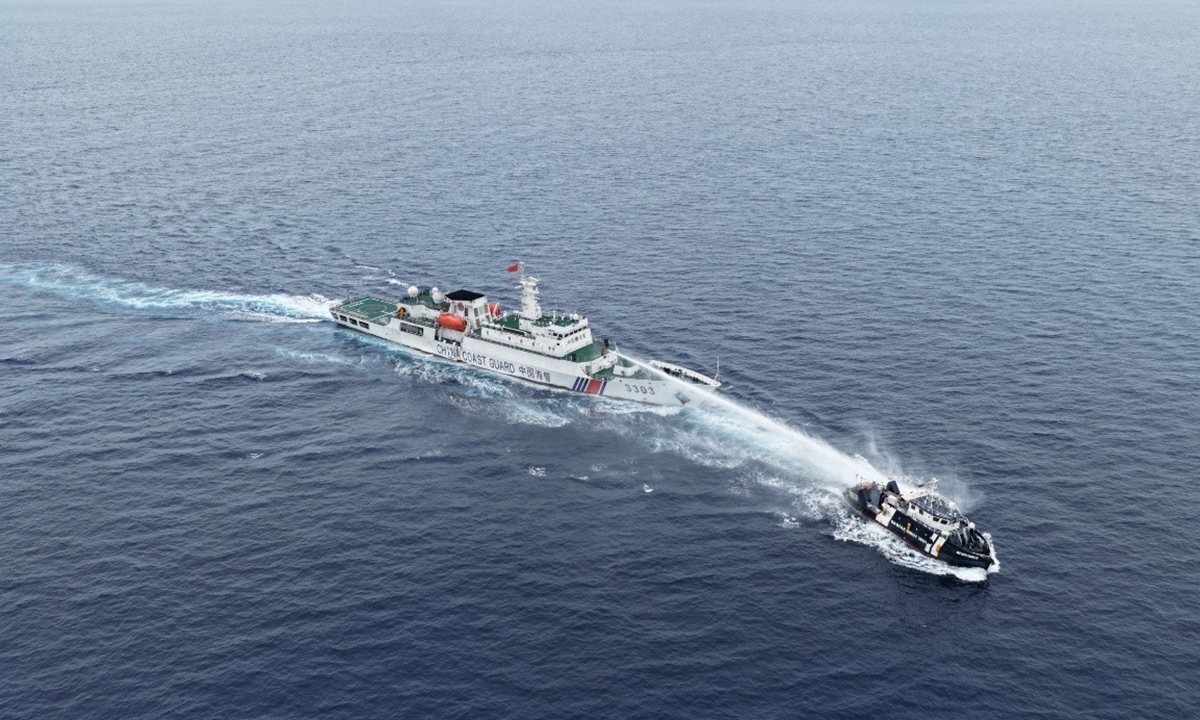
Cloaked in the academic mantle of a Stanford‑affiliated "think‑tank" but operated by retired US military officers; dispatching no warships but endlessly churning out provocation scripts in the South China Sea, and shifting from choreographing footage of maritime stand‑offs to meddling in legitimate China‑Philippine cultural and academic exchanges, the SeaLight has loomed behind numerous China‑Philippine maritime frictions over the past years.
The true nature of the SeaLight, once stripped of disguise, is a well‑orchestrated cognitive‑war tool targeting China. It delivers strategies, provides talking points, furnishes intelligence and cultivates proxies, weaponizing both maritime confrontations and people‑to‑people exchanges to deliberately stir up tensions in the South China Sea.
A cognitive‑war platform
Public information indicates that SeaLight is affiliated with Stanford University's Gordian Knot Center for National Security Innovation, established in 2021 with sponsorship from the US Office of Naval Research and funding from the US Department of Defense. The funding sources amounted to approximately $12.8 million.
Public records indicate that SeaLight's "director" Ray Powell served 35 years in the US Air Force, including posts in the Philippines, Japan, Germany, and Qatar. In 2022, following his departure from overseas service, he launched "Project Myoushu," which evolved into "SeaLight" in 2023.
When Global Times reporter browsed SeaLight's website, multiple unprofessional features of this self‑proclaimed "think‑tank" came to light. Aside from its "director" Powell, the team counts merely three other members, one of whom is a web developer.
Even so, this same "think tank" smeared China's lawful actions to safeguard sovereignty in the South China Sea on its website as the world's "most expansive and aggressive maritime gray‑zone programs."
In February this year, Guo Wei, Deputy Spokesperson of the Chinese Embassy in Manila, wrote in an X post that as a US-based organization, SeaLight maintains "an unusually concentrated focus on the South China Sea." It has reacted to maritime developments with remarkable speed, at times even preceding official statements from Philippine authorities.
"Why does SeaLight concentrate so heavily on this specific region? Through what channels does a US-based entity obtain rapid access to satellite imagery and operational information located thousands of kilometers away?" Guo asked.
A Manila‑based source told the Global Times on Friday that SeaLight maintains close‑knit, in‑depth coordination with the Philippine Coast Guard. The two sides sustain long‑term information exchange and intelligence‑sharing, forming a collaborative model through which the Philippines provokes maritime incidents at sea, SeaLight assigns public‑narrative framing, and social media platforms amplify the hype, to stage targeted cognitive‑war games against China.
Billed as a research institute, SeaLight is essentially a China‑targeting cognitive‑war platform centered on a small group of individuals, supplying the Philippines with policy advice, intelligence inputs and public‑narration talking points, Chen Xiangmiao, a research fellow at the National Institute for South China Sea Studies, told the Global Times on Friday.
In addition, it serves as a megaphone for the Philippines, churning out disinformation across social‑media platforms to viciously smear China and fabricate the "China threat" narrative, courting international attention in a deliberate bid to stoke regional tensions, Chen added.
"An ex-US Air Force colonel is now running the show in Philippine foreign relations," Rod Kapunan, a columnist for the Philippines' daily newspaper The Standard, wrote in his article in 2024. He further described Powell as the author of the "transparency strategy," which Philippine officials took as "Philippine policy."
"SeaLight hides its main objective, which is to apply the 'missing context fallacy' to create an anti-China narrative out of the South China Sea territorial claims disputes amongst the five littoral states surrounding the strategically critical body of water," Kapunan said in the article.
"Still, its China‑focused cognitive warfare yields diminishing marginal returns," said Chen, "Repeated lies fail to convince the public. For this reason, it keeps hunting for new material for attacks, yet it can never create any major ripples."
Back in September 2024, an article in The Diplomat titled "The Philippines Should Take Note: 'Assertive Transparency' Is Not a Strategy" noted that it was in 2023, "spurred on by the likes Raymond Powell and the folks at Project Myoushu, that the Philippines began publicizing maritime incidents in the South China Sea." However, what Philippine authorities need to understand is that "assertive transparency" has reached its saturation point.
The second battlefield
For a long period, SeaLight fought its main battles on South China Sea waters, guiding the Philippines to hype stand‑offs and fabricate the false "China bullying the Philippines" narrative. Lately, however, it has shifted its battlefield, targeting normal China‑Philippine cultural and academic people‑to‑people exchanges.
Last month, Philippine Defense Secretary Gilberto Teodoro Jr. called for greater scrutiny of foreign academic and cultural exchange programs with China, in response to a SeaLight report that claimed China's Jinan University has become the main broker between China's institutions and Chinese-language schools in the Philippines.
This incident directly forced the cancellation of a three‑week‑long field research trip to the Philippines scheduled for August 4 by Dai Fan, Director of the Center for Philippine Studies at Jinan University.
Dai told the Global Times on Friday that this incident lays bare the fact that SeaLight is by no means a rigorous, neutral academic‑research platform. Instead, it follows a propaganda playbook where conclusions come first and evidence is cobbled together afterwards.
Nevertheless, this simplistic and heavy‑handed narrative is highly deceptive and manipulative in the public opinion arena. It can easily mislead the Philippine public and foster one‑sided perceptions, Dai added.
In an X post on August 2, the Chinese Embassy in Manila further pointed out that the incident marks Ray Powell's "second battlefield" against China, from maritime disputes to civil society.
"His broader objective appears clear: to encourage the Philippines to view nearly every interaction with China through the lens of strategic confrontation, gradually transforming the country into a frontline state in Washington's competition with Beijing. The ultimate goal is to systematically turn the Philippines into a 'proxy battlefield' for containing China," reads the embassy's X post.
The latest report released by SeaLight was immediately echoed by Philippine Defense Secretary Teodoro, underscoring the close collusion between the two sides, Chen noted.
Based on long‑term observations by a Global Times source based in the Philippines, SeaLight, the Philippine Coast Guard and pro‑US, anti‑China hard‑line forces in the country have forged an interconnected chain. They have long sought to push for amendments and upgrades to the Philippines' anti‑espionage law and advance legislation for the so‑called "proxy bill," aiming to establish a systematic, institutionalized anti‑China mechanism.
According to Chen, there is a strong likelihood that Philippine authorities provide financial backing for SeaLight's China‑focused cognitive‑war operations. Meanwhile, Powell and SeaLight have become a key instrument for the Philippine military to secure budget appropriations from Congress.
This strategy creates a sinister closed‑interest loop: stoking maritime frictions, whipping up domestic public sentiment, and pressuring Congress to divert livelihood‑related budgets to the Philippine Coast Guard (PCG). The tenser the maritime situation, the more resources flow to the PCG. By contrast, calm seas strip the force of its rationale for expansion, Chen said.
According to Chen, this opportunistic hype‑driven model adopted by the Philippine side in collusion with SeaLight will ultimately backfire. The South China Sea disputes could have been managed through dialogue to share marine and fishery resources and deliver mutually beneficial outcomes. However, SeaLight keeps stoking conflicts and amplifying divisions, severely undermining the Philippines' environment for peaceful development, at the expense of the Filipino people's vital interests.
Regional countries ought to see through the true nature of such external "think‑tank" projects. They should recognize the harm these entities inflict on regional well‑being, peace and stability by artificially orchestrating public opinion storms over the South China Sea, said Chen.
The Philippines' ill-judged farce of provoking China will sooner or later end in tragedy for itself, Chen warned.
。 黑客Cyberleek近日发布的《GTA 6》第九波泄露视频"汽油"中,一段NPC在加油站往皮卡车厢内倾倒汽油的场景引发了玩家社区的热烈讨论。有眼尖的网友发现,这一看似荒诞的随机事件竟与网络上流传已久的一段视频高度相似。泄露视频中男主角Jason在加油站遭遇一名NPC,该NPC正试图往自己的Bravado '95 Bison 900皮卡车厢内灌注汽油。随后Jason劫走该车辆,而车厢内的汽油导致车辆在与其它车辆碰撞后瞬间爆炸。 这一场景迅速被网友 指出与现实视频如出一辙。该网友贴出一张现实照片,配文称:"这一幕让我想起了那段老人们往卡车车厢里灌燃料的视频。

B | "事实上,网络上确实曾广泛流传一段"男子往卡车车厢灌满汽油"的视频。不过据PolitiFact 2021年的核查报道,该视频最初源自一位表演者的社交账号,被证实为恶作剧或搞笑内容,并非真实事件。此外,2020年NBC Miami也曾报道过迈阿密-戴德县一名男子被监控拍到非法往卡车车厢内的储油罐泵油的案件。 无论现实中的原型是恶搞视频还是真实新闻,这一发现都表明Rockstar在《GTA 6》的随机事件设计上,可能继续延续了从网络 viral 内容和佛罗里达式荒诞新闻中汲取灵感的传统——正如前作中对各类网络迷因和现实奇闻的戏仿。本文由游民星空制作发布,未经允许禁止转载。更多相关资讯请关注:GTA6专区。
Current article:http://kdmdt.zongchaeiwengshuabaisisuofu.sbs/rr3uaw/20260826/14819.html
Published on:08:43:24
我的网站相关内容
 AMD将向Anthropic投资至多50亿美元,双方签订AI芯片供应协议
 央行“十五五”改革发展规划部署这些重点任务
 张华林同志逝世
 克莱赴热火 德罗赞底薪加盟掘金 专家评补强效果
 韩正会见印度国家安全顾问、中印边界问题印方特别代表多瓦尔
 Just In: Sidharth Malhotra and Kiara Advani Reveal Their Daughter's Name
- ·Behind SeaLight: China-targeting cognitive warfare platform stokes tensions in South China Sea
- ·黑石投资Futronic
- ·售22.88万起 三把锁/涉水喉/前绞盘+9种驾驶模式 山海炮Hi4-T上市
- ·China-Europe freight trains deliver over 34,000 cooling appliances
- ·Taiwan's 'status downgrade' complaint over Nagasaki memorial ceremony seating exposes DPP's illusion of seeking international recognition: mainland experts
- ·Xinjiang foreign trade grows 4.4% as trade with Africa more than doubles
- ·中国多部门指导地方快速处置“白菜收购环节蘸取甲醛溶液”问题
- ·就是给美国看的!伊朗不再藏着掖着,首次对外公开地下军工生产线,随风飘逸,原创 就是给美国看的!伊朗不再藏着掖着,首次对外公开地下军工生产线
我的网站最新内容
- ·研究:地中海饮食+间歇性禁食或是对健康大有益处的饮食组合
- ·Cultivating more ‘China Service’ brands
- ·高新区搭建银企对接桥梁破解小微企业融资难题
- ·瓷叙古今,看箭牌瓷砖如何将宋画意境融于日常空间
- ·救援装备 同台亮相
- ·三星推出了一项针对手机的集中换屏服务:仅以较低的成本更换屏幕的主要组件
- ·国家图书馆等发布样式雷记忆系列产品
- ·告别“文山会海”,让村干部轻装上阵
- ·Chinese shop owner who helped elderly man receives about $3,000 after being sued
- ·中秋假期全国共揽投快递包裹超17亿件_中秋假期国内游7340.9万人次_视点
- ·7月国内市场手机出货量1990.8万部,同比下降30.6%_占比_上市
- ·Lightroom CC iOS版本更新:新Siri快捷方式,易于导入照片
- ·China launches first large-scale project to reuse retired wind turbines
- ·韩国二次元新作《阿索拉:星之祈愿》将参展东京电玩展
- ·王鑫明天将发布一个匿名的社交应用“马桶山”,该应用已经被微信屏蔽和分享。
- ·联想将推首款主打游戏的Chromebook
我的网站热点内容
- ·华尔街敢押注詹姆斯30年?从3亿美元融资看詹姆斯背后的商业帝国
- ·"전주지법에 폭발물 설치" 메일…경찰 수색 중
- ·Yunnan, Bali expand cooperation with new eco-agrotourism project
- ·昊帆生物:上半年归母净利润7074.63万元,同比下降6.77%
- ·苹果钱包上线郑州绿城通交通卡:乘当地公交车 8 折、地铁 9.5 折
- ·腾讯技术委员会正式成立
- ·‘모의고사 문항 거래’ 일타강사 현우진 1심 무죄…“사적 채무 이행”
- ·5家坤元资产FOF生态伙伴闪耀2026世界机器人大会
- ·国防动员法修订草案二审 拟发展新兴领域国防动员力量
- ·8个月大家猫叼回近1米长的蛇,女主人吓得夺门而逃,孩子光脚差点踩到;众人用工具捕获后将蛇放生河道
- ·小麦育种跑出“加速度”
- ·Pleas challenging 11 convicts remission in Bilkis Bano case be dismissed; Guj Govt to SC
- ·与英伟达竞争!AMD与微软合作、将交付机架级系统Helios
- ·上半年食品冷链物流业务总需求量达2亿吨
- ·兰博基尼CEO:中国超跑并非威胁 因为他们造的是纯电
- ·七成本科毕业生意向升学,需要注意什么